
How to Find a Recent Arrest in Greene County
Most recent arrests show up on the Greene County Jail roster within a few hours of booking. The roster is the fastest free way to confirm a person is in custody and to see the charge list. The Sheriff's Civil and Records Division handles older arrest reports and incident reports through a written request.
- Open the official jail roster page at greenecountymo.gov/sheriff/division/detention/jailtracker.php.
- Read the disclaimer. Click through to the live JailTracker app.
- Pick a search type. The current roster lists all people booked at the time of the query.
- Type a last name, first name, or both. Use the released-since filter if you want recent releases.
- Complete the captcha if shown.
- Open a result to see mugshot, charges, bond, hold type, and arrest agency.
- For an older arrest, file a Sunshine request with the Sheriff's Civil and Records Division.
- Check Case.net through Greene County court records if the prosecutor has filed a case.
The roster changes fast. A person booked at 2 a.m. may post bond by morning. If a name is not on the roster, the person may have been released, transferred, or never booked into the county jail.
Greene County Jail and the JailTracker Roster
The Greene County Jail sits at 1199 N. Haseltine Road in Springfield. The Detention Division page says the jail has 1,242 beds and an average daily population near 730 inmates. The facility runs on a Modified Supervision philosophy and uses an objective classification system to sort housing pods. The image below shows the official Detention Division overview.
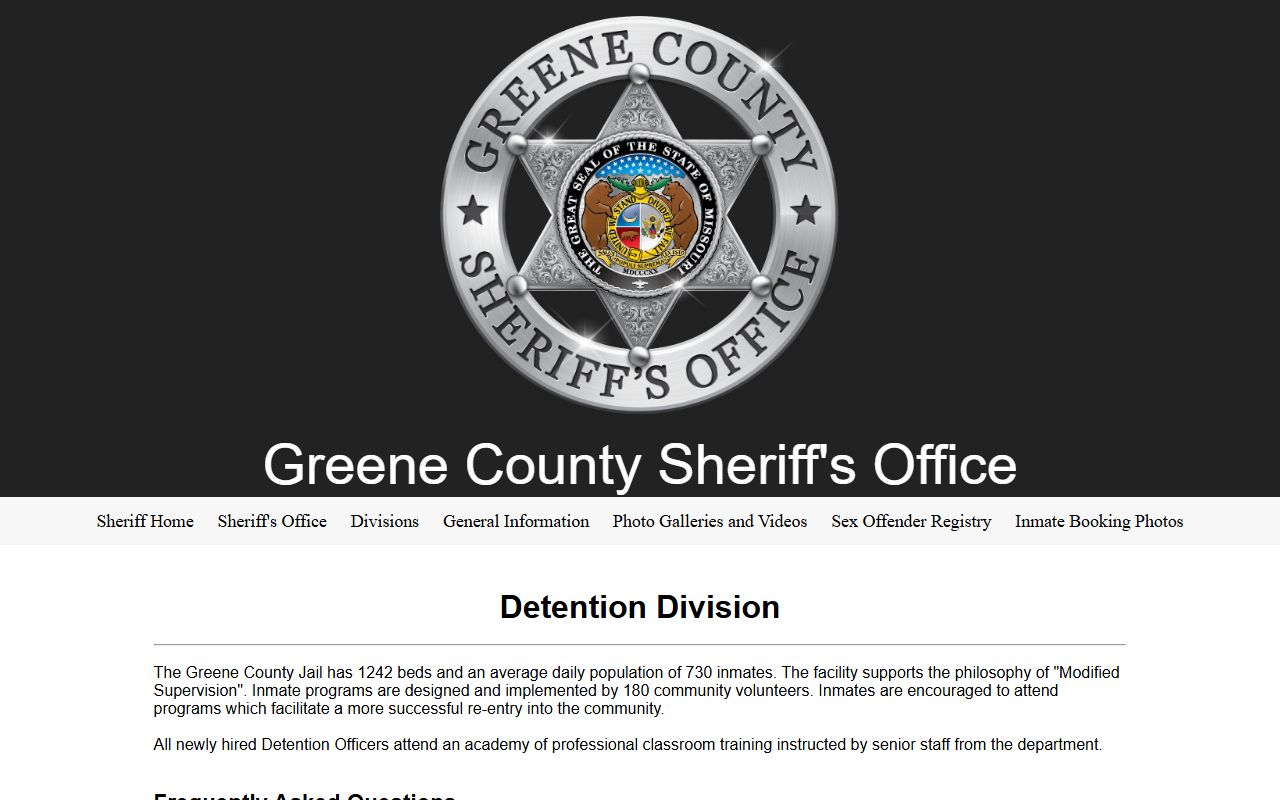
The Detention Division page is the best place to confirm jail capacity, the average daily population, and the general operating philosophy. It links out to booking, classification, visitation, mail, and the JailTracker roster.
The roster is hosted on a vendor system. The official Sheriff site redirects to it from a disclaimer page. The image below shows that official redirect.
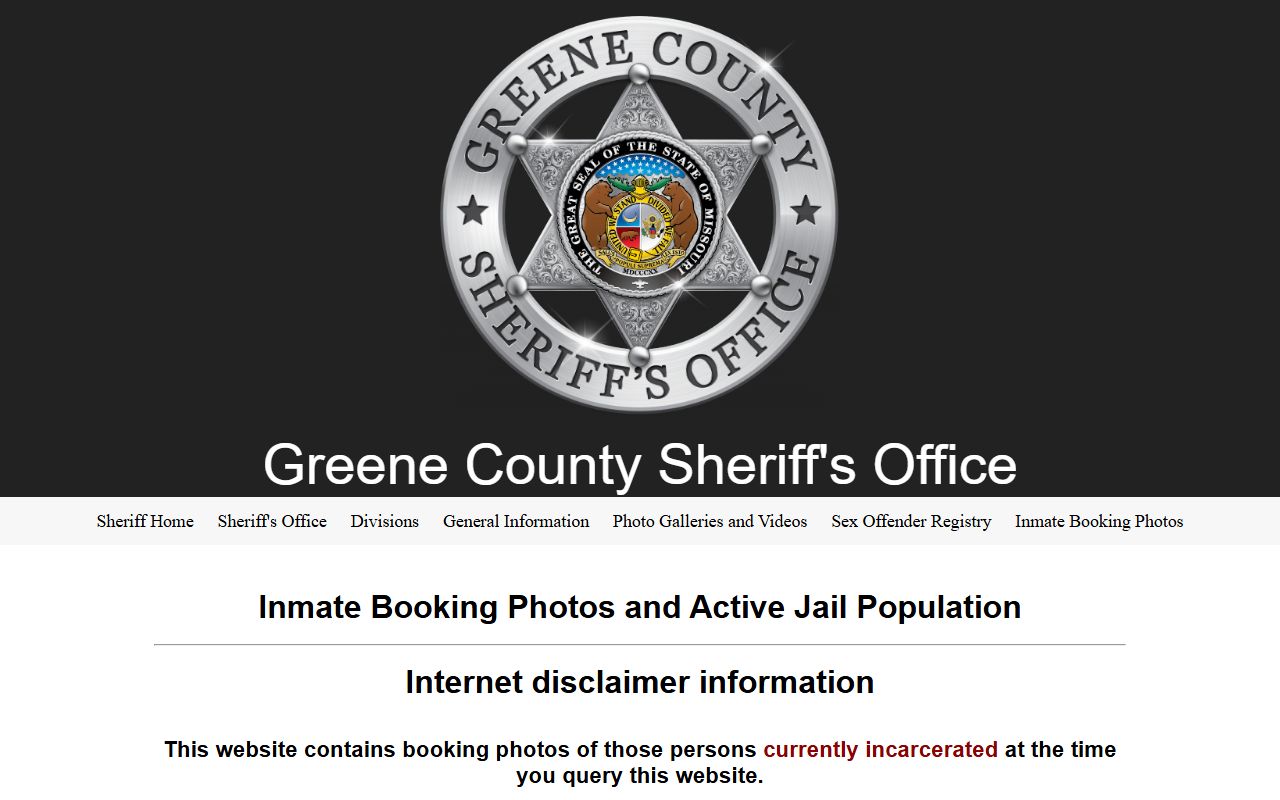
The disclaimer is short but it matters. It says the data is for information only, that an arrest does not mean a conviction, that the roster changes quickly, and that no one should rely on the page for legal action. Read it before you use a roster hit for anything serious.
What a Greene County Arrest Record Shows
An arrest record is the file the Sheriff creates at booking. It is not the court file. The JailTracker app and the official jail pages expose a fairly wide field set. Some fields are public on the roster. Other fields sit in the back-end and only the Sheriff or the court can pull them.
| Field | What It Shows |
|---|---|
| Mugshot | Booking photo taken at intake |
| Name | First, middle, last name as recorded by the arresting agency |
| Booking number | Unique jail booking ID for the event |
| Original book date and time | When the person was first booked into the jail |
| Arrest agency | Sheriff, Springfield Police, MSHP, Republic PD, or other |
| Charge description | Plain text of each charge filed at booking |
| Arrest code / statute | RSMo or ordinance code for the charge |
| Counts | Number of counts per charge |
| Crime type | Felony, misdemeanor, ordinance, infraction |
| Bond amount | Dollar amount set at booking or by judge |
| Bond type | Cash-only, surety, open court, or no-bond hold |
| Hold type | 24-hour, capias, warrant, ICE, other agency |
| Facility / housing | Current pod or special unit if shown |
| Court date / time | Next scheduled court appearance if entered |
| Release date / time | Final release date when applicable |
Not every field will show for every booking. Sealed records, juvenile bookings, and protected-party fields are held back. The roster also has a current-offenders-only flag, which means released people may not show in a default search.
Arrest Record vs. Criminal Court Record
These two records sound the same. They are not. An arrest record is a law enforcement file built at booking. A criminal court record is the court's file once the prosecutor files a case. The table below shows the split.
| Arrest Record | Criminal Court Record |
|---|---|
| Created by Sheriff or local police at booking | Created by Circuit Clerk when the prosecutor files |
| Held by Greene County Sheriff Civil and Records Division | Held by Greene County Circuit Clerk |
| Shows mugshot, booking number, arrest charges, bond at booking | Shows case number, charges as filed, judge, plea, sentence, docket |
| Found on JailTracker roster or by Sunshine request | Found on Missouri Case.net or at the Circuit Clerk |
| Governed by RSMo 610.100 and Sunshine Law | Governed by Court Operating Rule 2 and judiciary rules |
| Can exist with no case ever filed | Only exists after a formal filing |
| Mugshot may stay public after release | Conviction or dismissal entered as disposition |
For full case data and disposition, see Greene County court records. That page covers Case.net, certified copies, and the Circuit Clerk request rules.
Mugshots and the Official Disclaimer
The JailTracker mugshot is the photo a booking officer takes at intake. It is part of the public arrest record under Missouri law as long as it is not sealed or expunged. Third-party mugshot sites pull from the same source, but the data ages fast and the unofficial copies do not update when a person is released or cleared.
The official jail page lays out the philosophy that drives intake and the Modified Supervision model. The image below shows the Greene County Jail overview page.
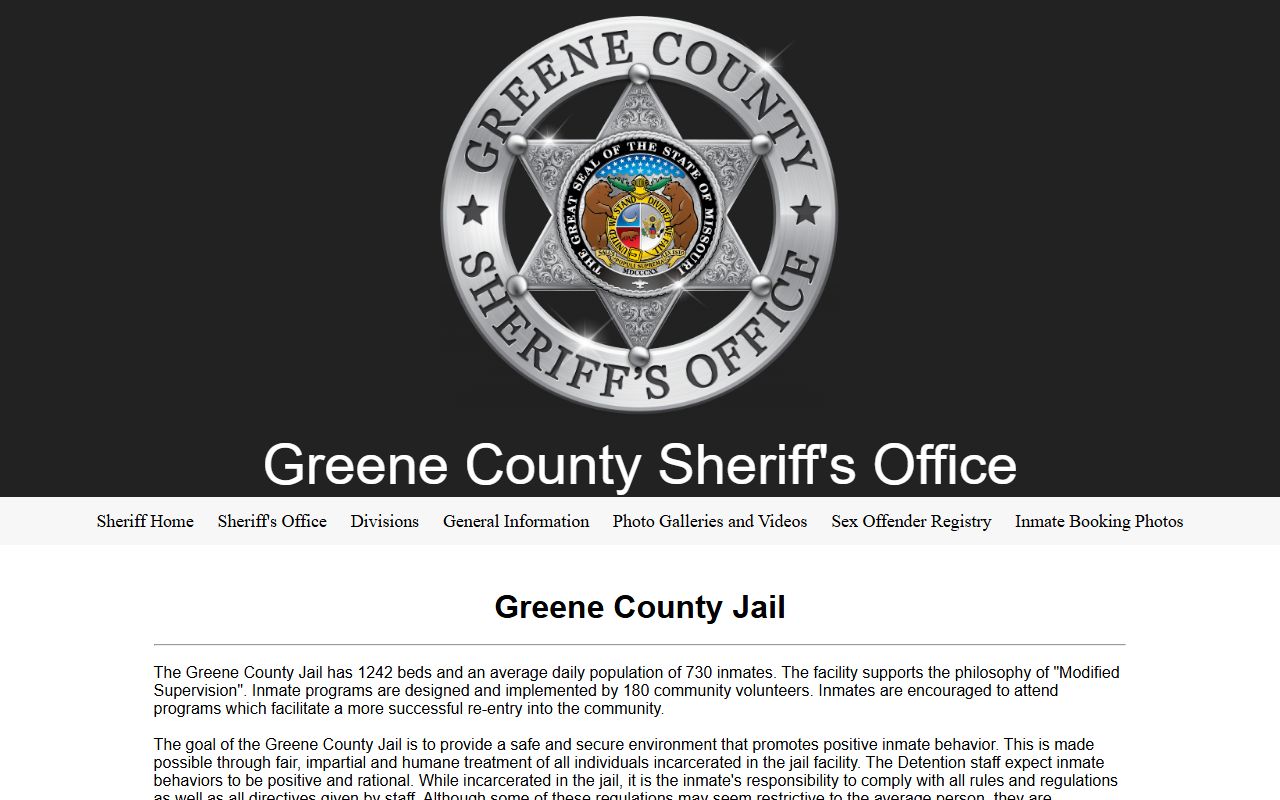
The official disclaimer on the roster is firm. It says the site contains booking photos of people currently incarcerated at the time of query, that information is for informational purposes only, that recent changes may not be reflected, that information changes quickly, that no warranty is made, that arrest does not mean conviction, and that information should not be relied on for legal action. An arrest is an accusation. A conviction is a court finding. The two are not the same.
Charges vs. Convictions
A charge is what the arresting agency or prosecutor writes down. A conviction is what the court enters after a plea, trial, or other disposition. Most arrest data shows charges. Court data shows the path from charge to disposition.
| Charges | Convictions |
|---|---|
| Filed by Sheriff at booking and by prosecutor in court | Entered by judge or jury after plea or trial |
| Can be dropped, amended, or refiled later | Final finding of guilt on the record |
| Visible on jail roster and Case.net case header | Visible as disposition and judgment on Case.net |
| Do not by themselves prove guilt | Establish guilt for sentencing and record use |
| May result in no case at all | Eligible for some forms of expungement after waiting periods |
| Often listed with counts and statute codes | Listed with sentence, fines, jail or prison time, probation |
For background-check use, the conviction record is the one that matters. An old arrest with no charge filed is still public, but it has no court finding behind it.
Bond Types and Release
Bond is the money or condition that lets a person out of jail before the case is over. Greene County uses several bond types. The jail's release rules also depend on hold type, shift changes, and meal times.
- Cash-only bond. Full cash amount plus kiosk processing fees must be paid to the jail. Release takes 2 to 4 hours after paperwork.
- Surety bond. A licensed bondsperson posts on the inmate's behalf. The fee is often near 10% of the bond amount. Processing also runs 2 to 4 hours.
- Open court bond. The inmate must appear before a judge to post, with or without a bondsperson.
- Capias. No bond is available. The person stays in custody until they see a judge.
- Twenty-four-hour hold. Release is 24 hours from arrest time.
- DWI four-hour hold. Release is four hours from arrest unless a 24-hour charge applies or more medical care is needed.
Some domestic assault, DWI, probable cause, capias, or book-and-release cases have no bond at first. The judge sets bond at the first appearance. See inmate records for the live custody view and released inmates for release timing and notice options.
Booking Process at Greene County Jail
The Sheriff's Booking and Release page lays out the intake steps. Every person taken into the jail goes through the same flow. The booking record feeds the JailTracker roster.
- The offender is taken to Booking on arrival.
- The Booking Officer asks records questions. The offender must answer.
- A wrist band is placed on the inmate and stays on at all times.
- No privileges, including commissary, visiting, or phone, are granted unless the ID band shows.
- Forms are completed. Medical staff are called if a serious issue shows up.
- Offenders who refuse medical or classification screening are segregated.
- A same-sex staff member searches the inmate for weapons or contraband.
- The inmate showers and changes into clean jail clothing.
- Personal property is inventoried and placed in the Property Room.
Classification follows booking. Custody level and prior history decide pod and program assignments. The jail does not let inmates pick their cell.
Public Access Laws for Arrest Records
Missouri splits court records and law enforcement records into two access frameworks. Court case records sit under Court Operating Rule 2. Sheriff arrest reports, incident reports, and other law enforcement files sit under the Missouri Sunshine Law, Chapter 610. The key statute for arrest data is RSMo 610.100.
Section 610.100 makes arrest report facts presumptively open. Investigative material can be closed while the case is active. Once the case is closed, more material may open up. A person can ask the Sheriff to expunge an arrest record where no charges were filed, the case was dismissed, or no probable cause existed. The path is set in RSMo 610.122.
The broader criminal record expungement statute is RSMo 610.140. It sets waiting periods, lists excluded offenses, and caps the number of expungements a person may seek. Petitioners file in the court where the case was heard. The court hears the petition, the prosecutor may oppose, and the judge can grant or deny.
Note: A sealed or expunged record is not erased. Law enforcement, courts, and certain licensing or employment contexts may still have access as Missouri statute allows.
Sealed vs. Expunged Records
People use these two words like they mean the same thing. They do not. A sealed record is closed from public view but still exists in the system. An expunged record is treated as if it never happened for most purposes, with statutory limits.
| Sealed Record | Expunged Record |
|---|---|
| Closed from public access by statute or court order | Removed from public access and treated as if it did not occur |
| Record file still exists in court and agency systems | Record may be ordered destroyed or limited by statute |
| Covered by Court Operating Rule 2 and case-specific orders | Covered by RSMo 610.122 and RSMo 610.140 |
| Includes juvenile records, adoption files, certain protection-order data | Includes arrests with no charges, qualifying dismissed cases, qualifying convictions |
| Law enforcement and courts still see the file | Law enforcement, courts, and certain employers still see it under statute |
| Can be unsealed by motion or court order | Some offenses are not eligible for expungement at all |
If you think a Greene County arrest may be eligible, the petition is filed in the court where the case or arrest happened. The Circuit Clerk has forms for confidential record inspection requests on the local court forms page.
Greene County Criminal Court Records
Criminal court records are the next step after arrest. Once the Greene County Prosecutor files a charge, the Circuit Clerk opens a case file. The case file lives on Missouri Case.net and at the Judicial Courts Facility downtown. For full case-level coverage, see Greene County court records. That page covers Case.net search fields, certified copy fees, and Circuit Clerk request rules.
For active hearings and dockets, see Greene County court dockets. Traffic-criminal cases such as DWI route through both criminal and traffic systems; see traffic court records for citation-side lookups. Active warrants from open cases show in Greene County warrant records.
Greene County Sheriff and the Records Division
The Sheriff's Office runs jail operations, road patrol, civil process, and the Civil and Records Division. Sheriff Jim Arnott was first elected in 2008 and re-elected in 2012 and 2016. In March 2026 the county named Jason Johnson as interim sheriff pending Sheriff Arnott's expected move to a U.S. Marshal post. The image below shows the official interim sheriff page.
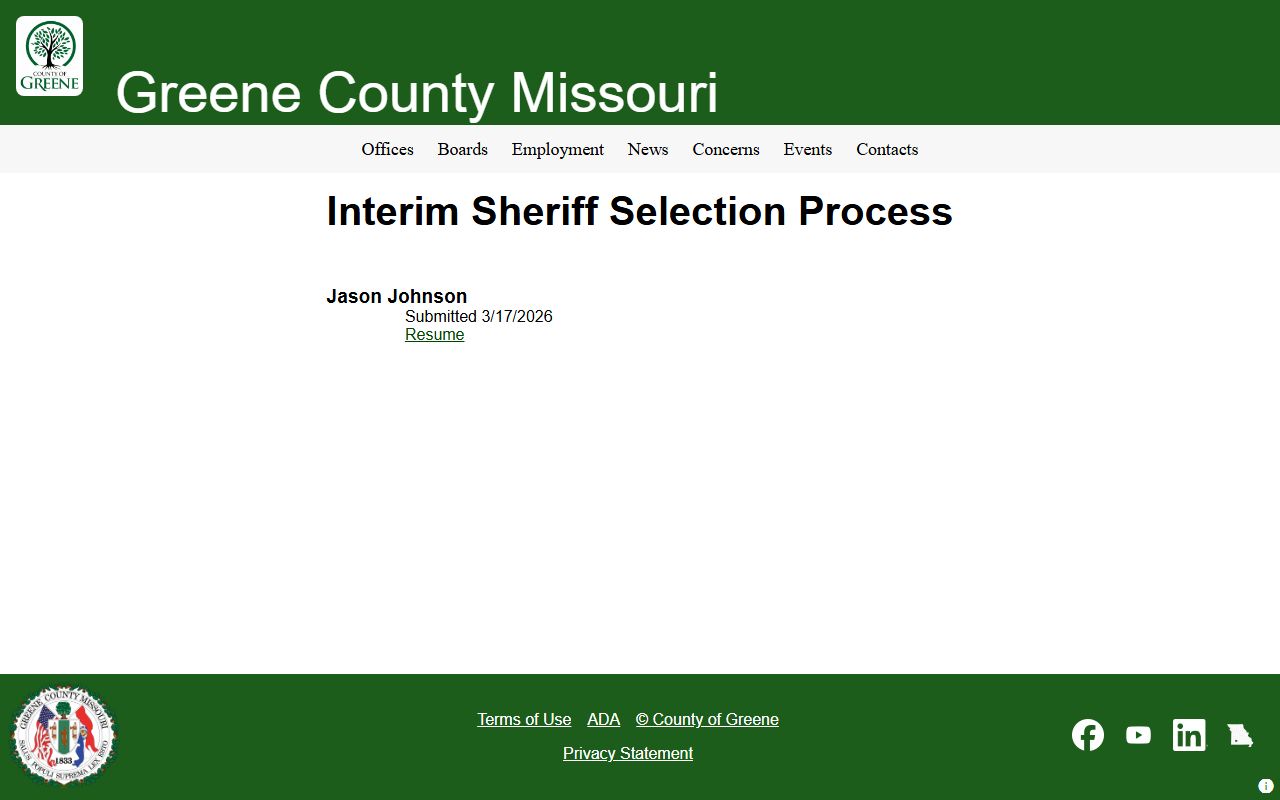
The Sheriff's Civil and Records Division is the office for arrest report copies, incident report copies, and other law enforcement record requests. Use the Sheriff Sunshine page for the official request form and current fees.
Greene County Sheriff's Office
5100 W. Division Street
Springfield, MO 65802
417-868-4040
Records: 417-868-4042
records@greenecountymo.gov
Greene County Jail
1199 N. Haseltine Road
Springfield, MO 65802
417-868-4048
1,242 beds · ADP near 730
Records requests should list the report number, the crime address, names of involved parties, identifying information, and the purpose of the request. Staff process and redact reports under Chapter 610. Photo ID or a signature may be required for some requests.
State and Federal Background Checks
A Greene County arrest record is one piece of the picture. A full background check pulls from state and federal sources too. The Missouri State Highway Patrol runs the statewide criminal record system. The Missouri Sex Offender Registry, also at MSHP, is a free public search. Try the Missouri Sex Offender Registry search first for any registry concerns.
For a full Missouri criminal record, MSHP processes name-based and fingerprint-based requests through the Criminal Justice Information Services Division. Name-based checks are open to anyone. Fingerprint checks have stricter rules and usually need a statutory or employer purpose. Federal-level checks come from the FBI Identity History Summary process. The image below shows the Greene County Jail visitation page, which links into the broader detention system.
For mail and contact at the jail, the official Offender Mail page sets the rules.
None of these are arrest record searches in the strict sense. They round out the arrest data with conviction, custody, and registry information.